Structural Drying and Dehumidification in Apple Valley, MN
Drying turns a wet house into a dry one, and a dry look is not the same as dry framing. The drying crew matches air movers and dehumidifiers to the loss and tracks readings until the materials get there.
(888) 432-4933Start the drying in Apple Valley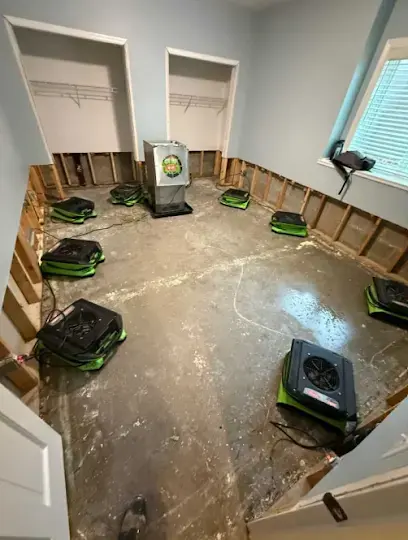
Equipment alone does not dry a building. The result depends on how well the setup matches the material, the room and the class of loss, and on whether someone checks the readings every day.
First steps for structural drying and dehumidification in Apple Valley
Stop the source
Drying cannot work while water is still entering the house.
Remove standing water
Extraction comes first so the equipment has less to evaporate.
Keep units running
Switching equipment off at night stretches the dry-out.
Leave the heat on
A moderately warm house helps moisture evaporate, winter included.
How structural drying and dehumidification is handled in Apple Valley
The tech who does the walkthrough maps moisture before any equipment goes down, so the drying plan matches what is actually wet. Equipment stays until the readings say dry, not until it looks dry.
- 1
Map the loss
A moisture map and a dry reference set the goal.
- 2
Choose equipment
The loss class decides air movers and dehumidifiers per room.
- 3
Adjust daily
Each day's readings steer equipment moves and any removal.
- 4
Confirm the finish
Materials end up close to the dry reference.
What shapes drying in Apple Valley homes
Of Apple Valley's 22,013 housing units, roughly 5,035 date from 1990 to 1999, 4,562 from 1980 to 1989 and 4,429 from 1970 to 1979. That mix means framing, subfloor and slab of many types, and each one gives up water at its own pace. Attached homes add shared walls and floors that need drying on both sides.
- Wood framing and subfloor in walls and floors.
- Concrete and block in lower levels.
- Hardwood and engineered flooring that holds water.
How a drying setup is planned
Moisture mapping and a dry reference reading set the goal first. Each room's equipment count follows from the class of loss: LGR units cover most jobs, while desiccant units take on concrete and dense material. Cavity drying pushes air into walls through small holes. Daily readings steer the moves, and the target is a reading within 2 to 4 points of the dry reference. A flooded lower level is explained on basement flooding cleanup.
- Equipment is repositioned as readings change.
- Walls are opened only when meters show wet board or insulation.
- The units stay until the final readings are in range.
What the readings do for a claim
An adjuster looks for proof that drying met a recognized standard. Daily readings, equipment counts and the final dry reference serve as that proof, and they protect the owner if a question comes up later. Coverage depends on the policy, and your own insurer decides it. The first step of most losses is water extraction.
Structural drying and dehumidification across Apple Valley and nearby towns
Structural drying calls cover ZIP 55124, from Downtown Apple Valley, Farquar Hills and Longridge to Cobblestone Lake, Pennock Shores, Galaxie Commons, the homes near Hayes Park and the area off Interstate 35E.
The same service nearby: structural drying and dehumidification in Burnsville, Eagan, Lakeville.
Water damage restoration in Apple Valley · every town covered
Related water damage services in Apple Valley
Structural Drying and Dehumidification questions in Apple Valley, MN
01How is dry defined?
Dry means materials read close to a reference taken in an unaffected area, which is not the same as feeling dry.
02Would open windows do the job?
Outside air can be as humid as indoor air. Dehumidifiers remove moisture on purpose and work in damp weather too.
03What makes an LGR unit different?
A low grain refrigerant unit keeps pulling moisture from air at low humidity, which is what keeps drying going near the end.
04When are desiccant units used?
They handle concrete, block and dense materials that give up water slowly, often alongside LGR units.
05Why is the noise so constant?
Air movers must keep air moving across wet surfaces, and the dehumidifiers work hard. The noise means the system is running.
06How many days should drying run?
Three to seven days is usual, with more time for thick framing, concrete or hardwood.
Need a building dried out in Apple Valley? Reach the crew.
Looking dry is not being dry. Readings decide when the equipment leaves.
Burnsville Water Damage Restoration · Burnsville, MN