Structural Drying and Dehumidification in Eagan, MN
After the water is out, drying is what actually returns a house to normal, so looks do not decide the finish. The Eagan crew picks equipment for the class of loss and records readings until each material hits its target.
(888) 432-4933Start the drying in Eagan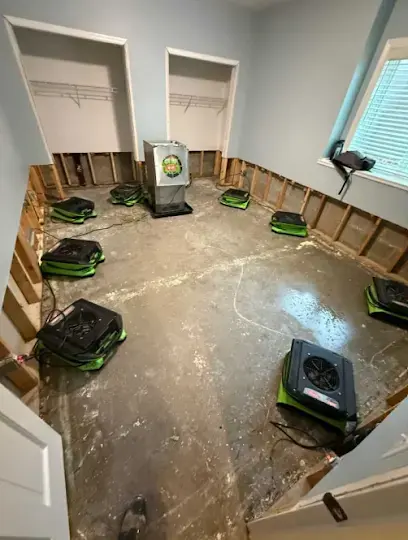
When the standing water is gone, the water left inside materials still has to come out. Drying is a managed process of equipment, airflow and measurement, and it is what protects framing and subfloor from rot.
First steps for structural drying and dehumidification in Eagan
Stop the source
Close the valve or fix the leak before drying begins.
Get the water out
Pull standing water before anything else.
Let the gear run
Fans and dehumidifiers work around the clock, so leave them on.
Keep the house warm
Heat speeds evaporation, so hold a normal temperature.
How structural drying and dehumidification is handled in Eagan
The tech who does the walkthrough maps moisture before any equipment goes down, so the drying plan matches what is actually wet. Equipment stays until the readings say dry, not until it looks dry.
- 1
Chart and benchmark
Meters take dry readings from unaffected material and chart the wet zone.
- 2
Select the gear
Air movers and dehumidifiers are chosen to fit the class of loss.
- 3
Tune daily
Units are moved and adjusted as readings fall.
- 4
Confirm and remove
Equipment leaves only when readings match the reference.
What shapes drying in Eagan houses
Most Eagan homes were built from 1980 to 1999, about 9,658 in the 1980s and 6,583 in the 1990s, with the median year at 1988. In houses of that age, carpet over pad on concrete, finished lower levels and plenty of drywall are common. Water in that mix moves between layers, so drying has to reach the subfloor, wall bottoms and slab rather than stop at the surface.
- Carpet and pad over concrete slabs in lower levels.
- Drywall and insulation in outside walls and ceilings.
- Cabinets and floating floors in kitchens and baths.
Setting up the drying system
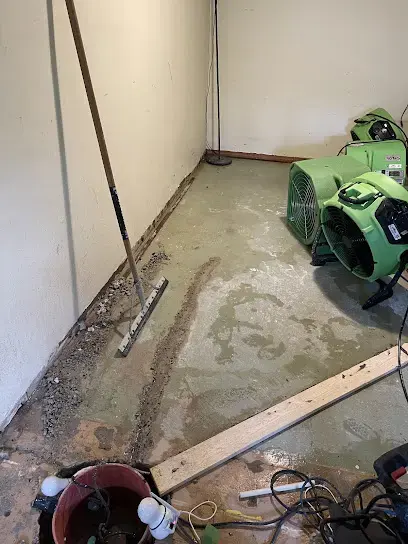
A dry reference is recorded from unaffected material, and the wet zone is mapped against it. Air movers sweep surfaces, LGR dehumidifiers pull moisture from the air, and desiccant units take over for concrete, hardwood and cold rooms where LGR units slow down. Each day the equipment is adjusted as readings fall, and the house stays warm to speed evaporation.
- Wall cavities are dried with injected air through small holes.
- Equipment output is sized to the class of loss, not to a rule of thumb.
- Equipment is pulled only once the readings match the reference.
What the daily logs prove
An adjuster wants to know the structure was dried to a standard, and the daily psychrometric record shows exactly that, along with the equipment count and the readings. Check the policy with your own insurer. The first step of most jobs is described on water extraction, and a common source is covered on burst pipe water damage.
Structural drying and dehumidification across Eagan and nearby towns
The Eagan drying crew sets equipment across ZIPs 55121, 55122 and 55123, including Blackhawk, Thomas Lake Heights, Cherrywood, Cedar Cliff, Central Eagan and South Eagan, whenever readings call for it.
The same service nearby: structural drying and dehumidification in Burnsville, Apple Valley, Bloomington.
Related water damage services in Eagan
Structural Drying and Dehumidification questions in Eagan, MN
01What counts as dry?
Materials that read within two to four points of an unaffected sample of the same type, not just materials that feel dry.
02Why not simply open the windows?
Outdoor air is often as damp as the room, and open windows cannot reach wall cavities or a slab. Controlled dehumidification is faster.
03What makes an LGR dehumidifier different?
It is a low grain refrigerant unit that dries air to a lower moisture level than a standard dehumidifier, which helps in cooler rooms.
04At what point do desiccant units get added?
For concrete, block, hardwood and very cold rooms, where refrigerant units lose efficiency.
05Why is there so much noise?
Air movers and dehumidifiers run day and night to push air through wet materials. The noise ends once readings match.
06How long will drying last?
Three to seven days is typical. Class 4 materials and multi-level losses can take longer.
Need an Eagan structure dried? Call today.
Surfaces can feel dry while framing is not, so meter readings, not appearances, end the job.
Burnsville Water Damage Restoration · Burnsville, MN