Structural Drying in Lakeville, MN
A room can look dry long before the framing is. After the water is out, the drying team sizes equipment to the loss, records temperature and humidity daily and runs machines until framing, subfloor and slab all measure dry.
(888) 432-4933Wet building? Call now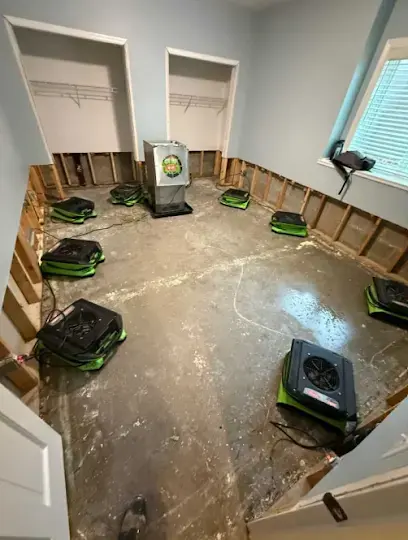
Drying is controlled evaporation. Water moves out of materials only when the air around them is warm, moving and thin on moisture, and the whole job is arranging those conditions and proving they worked.
First steps for structural drying and dehumidification in Lakeville
Stop the source
Close the valve or stop the leak so nothing new feeds the room.
Remove standing water
Pumping first leaves far less for the dehumidifiers to handle.
Leave equipment on
Machines are loud but turning them off stalls the drying.
Keep the house warm
Warm air dries faster, so hold the thermostat steady.
How structural drying and dehumidification is handled in Lakeville
The tech who does the walkthrough maps moisture before any equipment goes down, so the drying plan matches what is actually wet. Equipment stays until the readings say dry, not until it looks dry.
- 1
Classify the loss
Materials and water spread set the class and the equipment count.
- 2
Set the machines
Air movers and dehumidifiers are placed to move and strip moisture.
- 3
Monitor daily
Temperature, humidity and moisture are measured and recorded.
- 4
Release at the goal
Equipment leaves when materials read within range of the dry reference.
What shapes a Lakeville dry-out
Most Lakeville homes are newer: roughly 6,159 were built from 1990 to 1999, 6,189 from 2000 to 2009 and 4,644 from 2010 to 2019, with a median around 1999. Wood framing, plywood subfloor and finished lower levels are the materials a drying plan has to reach, and warehouses at Airlake Industrial Park bring slabs and larger spaces.
- Framing and subfloor that hold water after a leak.
- Concrete slabs that release moisture slowly.
- Hardwood and engineered floors that cup when wet.
- Big open rooms that need more machines.
Setting up the drying system
The technician works out the class of the loss from the materials involved and measures the room's temperature and humidity. That sets how many air movers, LGR dehumidifiers and, for slab or dense wood, desiccant units the room gets. Air movers sweep the wet surfaces, dehumidifiers remove the water from the air, and injection systems push air into hidden cavities. Water extraction comes first, since it removes the bulk of the water.
- Temperature and humidity are logged every visit.
- Machines are moved as areas dry.
- Equipment goes only when readings are near the reference.
Why the logs matter
Adjusters decide how many days and machines to pay for from the records. The moisture map, the daily psychrometric readings and the final numbers explain why each machine was there. Coverage depends on the policy, so check with your own insurer. A wet lower level is covered in basement flooding cleanup.
Structural drying and dehumidification across Lakeville and nearby towns
The Lakeville drying team covers ZIP 55044, from Downtown Lakeville and Fox Meadows to Dodd Marsh, Ritter Meadows, Great Oak, Orchard Meadows of Lakeville and Argonne, plus the buildings at Airlake Industrial Park.
The same service nearby: structural drying and dehumidification in Burnsville, Apple Valley, Savage.
Related water damage services in Lakeville
Structural Drying and Dehumidification questions in Lakeville, MN
01Why do the machines stay for days?
Wood and concrete give up moisture slowly. Drying stops only when readings show the materials are down to the dry reference.
02How do you know when it is dry?
Meters compare wet areas against an unaffected sample of the same material, and the logs record the numbers.
03Does the house have to stay warm?
Yes, since warm air holds and moves more moisture. A steady thermostat speeds the dry-out.
04What is a desiccant unit?
A dehumidifier that uses a drying wheel rather than coils, helpful for slabs and dense materials.
05Can walls be dried without opening them?
Often, using small holes and injected air, though soaked insulation still has to come out.
06Will insurance pay for the days?
Reasonable drying is usually part of a covered loss. Confirm the details with your own insurer.
Wet framing or slab in Lakeville? Set up the dry-out.
Moisture left in framing and subfloor causes trouble later. Measured drying settles it.
Burnsville Water Damage Restoration · Burnsville, MN