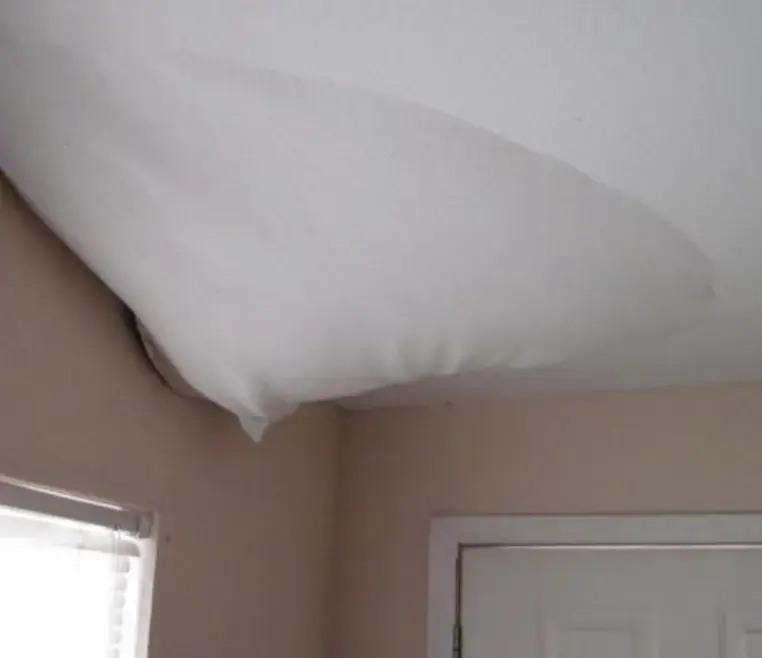
A brown stain spreading across a ceiling is alarming, and in a townhome or condo the source may not be anywhere in the home. In Apple Valley, with thousands of attached homes, a neighbor's leak is a common way for water to arrive.
Key takeaways
- Apple Valley has 6,061 attached homes such as townhomes, and about 2,339 housing units sit in buildings of 50 or more units.
- A ceiling leak that starts in the unit above is treated as a shared loss: the source, the path and the damaged rooms are all documented.
- Do not stand under a sagging ceiling. The drywall holds water and can drop without warning.
- Tell the neighbor or the property manager right away so the water to the source can be shut off.
- Joist bays and wall cavities are dried along with the ceiling, because water travels along framing.
How a leak in the unit above reaches your ceiling
Water follows gravity and the easiest path. A leak in an upper unit soaks the floor, runs along the joists and drips through light fixtures, vents and drywall seams below.
The first sign in the unit below is often a faint stain, a bubble in paint or a sagging patch. By then the joist bays above the ceiling may hold far more water than the surface shows.
In a townhome row or a larger building, a pipe can carry water for some distance before it breaks through. The room where the ceiling shows damage may be a long way from the room where the water began.
That is why stopping the source and mapping the path are the first jobs, ahead of any repair.
Apple Valley's attached housing
Apple Valley has 22,013 housing units, and the city's housing count shows how common shared walls and floors are.
Those counts matter because a shared wall or floor means a shared risk. A leak in a home like that is rarely only one household's problem.
- 6,061 of the homes are attached, such as townhomes.
- About 2,339 units are in buildings with 50 or more units.
- Of 21,627 occupied homes, 5,747 are renter occupied.
- Most homes in the city were built from 1970 to 1999.
What to do when the ceiling sags
A bulging ceiling is holding water, and it can fail all at once. The first steps focus on safety and on stopping the source.
If the unit above is empty or no one answers, the property manager or the building emergency contact can shut off the supply. Ask for that step by name.
- Move people and pets out of the room below the sag.
- Turn off the lights and the circuit for that room if water is near a fixture.
- Knock on the door of the unit above, or call the property manager, to ask that water use stop and the supply be shut off.
- Place buckets and move furniture, but do not poke the ceiling yourself.
- Photograph the stain, the sag and any water on the floor.
Finding where the water came from
The source decides what happens next, and it is not always inside the unit above.
A neighbor's appliance or fixture
A washer hose, a dishwasher hose, an overflowing tub or a failed toilet supply are common sources. A homeowner or renter above may not even know it happened.
The Apple Valley appliance leak water damage page covers how these leaks soak floors and cabinets before the water drops through.
A shared pipe or the building
A supply or drain pipe in a shared wall, a roof leak or a failed fixture in a common area can reach several units at once.
In that case the manager or association usually coordinates the repair, and each unit documents its own damage.
How the drying works
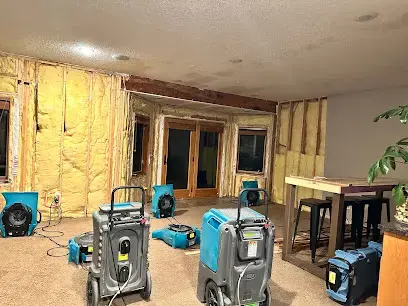
The restoration team starts by mapping where the water has gone with a moisture meter and a thermal camera. Wet drywall that is sagging is opened so the water can drain and the cavity can dry.
Insulation in the ceiling that is soaked is removed, and joists and subfloor are dried with air movers and dehumidifiers. For a closer look at how that work is scoped, see the Apple Valley ceiling leak water damage page.
The team also checks light fixtures and bath fans in the ceiling below, since water follows wires and ducts. A fixture that has taken on water is turned off until it has been checked.
- Moisture mapping marks every wet area, including those outside the stain.
- Sagging drywall is cut open to let water out.
- Wet insulation is removed and framing is dried in place.
- Readings are taken daily until framing reaches the drying goal.
Who is responsible and what to document
Responsibility depends on the cause. A neighbor's appliance, a building pipe and a roof leak lead to different parties and different policies, and the association documents often say which applies.
Whichever way it goes, a clear paper trail speeds the claim. Keep the file organized from the first day.
Insurance often involves two policies: the policy of the person whose unit leaked and the policy of the person whose unit was damaged. The restoration team documents the loss the same way in either case.
- Photograph the damage, the source if it is visible and the date.
- Write down who was notified and when.
- Ask the property manager or association for the master policy and the repair plan.
- Keep the restoration team's moisture readings and scope.
Living in the unit during drying
Drying equipment is loud, and it runs for several days. Most households stay in the home while air movers and dehumidifiers work, though the affected room is often off limits.
For the full picture of how the restoration team handles leaks like this across the city, see the Apple Valley water damage hub or the Burnsville ceiling leak page.
Questions
What should be done first when a ceiling sags?
Move people and pets out of the room, turn off power if water is near a light fixture and ask that water use stop in the unit above. Do not stand under the sag.
Can a leak in the unit above damage drywall that looks dry?
Yes. Water travels along joists and soaks insulation, so the surface can look dry while the cavity above is wet. Moisture mapping finds the full area.
Who pays when a neighbor's leak damages a unit?
It depends on the cause and the policies involved. A neighbor's appliance, a shared pipe and the building each lead to different parties, so check the association documents and the insurance policy.
Is the sagging ceiling always removed?
A sagging ceiling that holds water is opened. Drywall that stays wet is usually removed and replaced, and drywall with only a faint stain may be dried after readings.