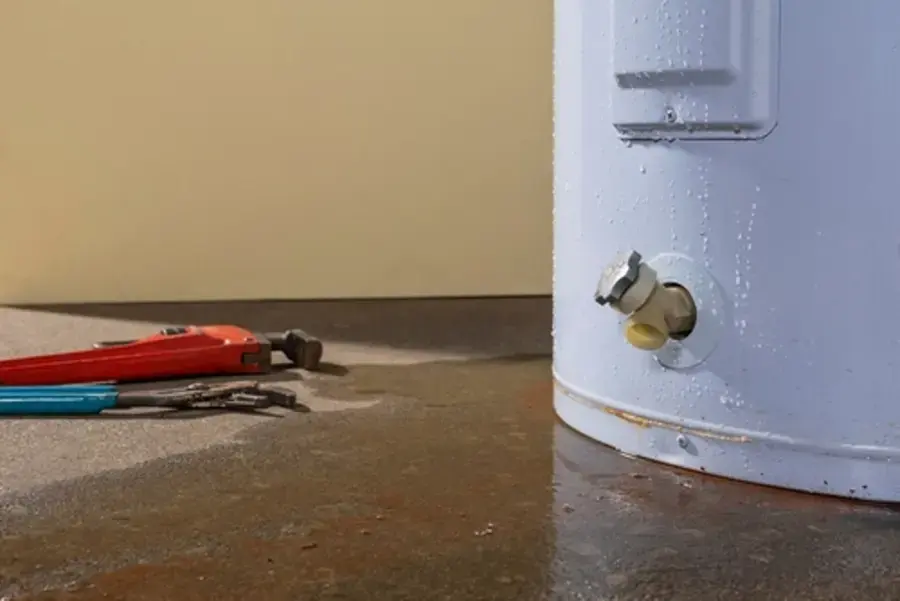
Lakeville homes are newer than most in the south metro, and a water heater in one of them is not old by calendar standards. Even so, the water that runs through the tank can wear it down faster than owners expect.
Key takeaways
- The City of Lakeville says its water is 18 grains per gallon hard, and the city suggests setting a softener to 14 to 16 grains to help prevent corrosion in home plumbing.
- Hard water can leave scale in a tank, and scale and corrosion are common roads to a leak.
- A leaking tank is replaced, not patched, and shutting off the supply and the power or gas to the unit is the first step.
- In a garage or utility room, water spreads across the slab. In a finished space, it moves into walls and flooring.
- Extraction comes first, then moisture readings decide what is dried and what is removed.
Why hard water matters to a tank
Water hardness is a measure of dissolved minerals, and those minerals settle out when water is heated. Over the years they form scale at the bottom of a tank and on any heating parts.
Scale makes a tank work harder and can trap sediment against the steel, which speeds up corrosion. The leak that follows often starts at the base or a seam, not at a visible fitting.
A softener changes how that hardness behaves in the home. A setting that is too low leaves scale in the tank, while the settings suggested by the city aim to protect plumbing from corrosion.
None of this means a tank will fail on a schedule. It means the water that runs through it matters.
Lakeville's water and housing numbers
The city and the census give a useful picture of the setting a Lakeville tank works in.
- The Lakeville Water Treatment Facility removes iron and manganese, and it was built in 1998 and expanded in 2001 and 2015.
- City water is 18 grains per gallon hard.
- The city suggests a softener setting of 14 to 16 grains to help prevent corrosion in home plumbing.
- The median year a Lakeville home was built is 1999, with 6,159 homes built from 1990 to 1999 and 6,189 from 2000 to 2009.
Signs a tank is nearing failure
A tank rarely fails without a hint. The signs below give a homeowner a chance to replace it before the floor floods.
A tank can look fine from the outside and still be weak underneath. Owners who spot two or more signs together should plan a replacement before the next cold season.
- Rust colored water or rust streaks near the base of the tank.
- Popping or rumbling as the tank heats, a sign of sediment.
- Moisture or white crusty mineral deposits around fittings and the relief valve.
- A puddle that returns after being wiped up.
- A tank that has run for many years in hard water.
When the tank lets go: the first steps
A leaking tank is an emergency in a small room. The aim is to stop new water, protect people and start extraction.
If the leak is small and slow, a towel and a bucket buy a little time, but a slow leak still wets the floor and the wall base. Treat it as a leak worth cleaning up, not a drip worth ignoring.
- Turn off the cold water supply valve on top of the tank.
- Switch off the power at the breaker, or set a gas unit to its off position.
- Keep out of standing water if it could reach an outlet.
- Photograph the tank, the floor and anything on it.
- Call a Lakeville water heater leak cleanup team to start extraction.
Where the water goes in a newer Lakeville home
Where the tank sits changes how far the water travels.
In a garage
Water spreads across the slab and under stored items. It can also run under the wall into the living space if the slab is close to the floor level.
Cardboard boxes, tools and anything stored at floor level soak first.
In a utility room or finished lower level
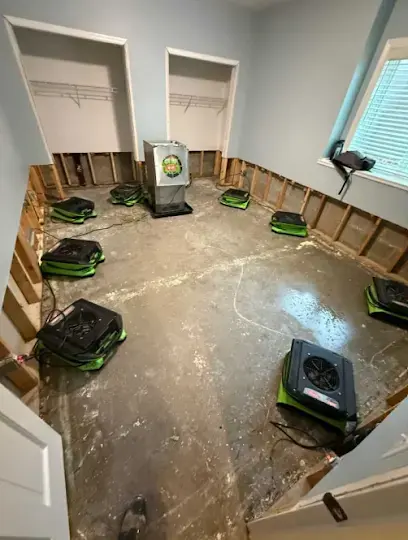
Water reaches the drywall bottoms, baseboards and flooring. Carpet pad soaks up a lot of water and holds it.
A finished space hides water, so readings behind walls matter.
In a closet or upper level
A tank on an upper floor sends water through the subfloor and into the ceiling below. The downstairs room may show a stain before anyone knows the tank has failed.
Cleanup, extraction and drying
The first job is to pull standing water with a pump or extractor. A moisture meter then shows how far the water traveled into walls, flooring and concrete.
Wet carpet pad and drywall that stayed wet are removed, and the remaining structure is dried with air movers and dehumidifiers. The Lakeville water extraction page describes how the work is scoped.
A garage slab is the simplest case, because concrete does not swell. A finished floor is harder, since laminate and wood buckle once water gets under them.
- Extraction first, then moisture mapping.
- Soaked insulation behind a tank is removed, not dried in place.
- Flooring that traps water, such as sheet vinyl over a wet subfloor, is lifted.
- Readings are repeated until framing and slab reach the drying goal.
Replacement, softener settings and insurance
A leaking tank is replaced. While the plumber is on site, ask about the water softener setting, since the city suggests 14 to 16 grains to help prevent corrosion in home plumbing.
Coverage for a tank leak depends on the policy. Many policies cover sudden water damage, and the tank itself may be treated separately, so read the wording or ask the insurer.
For the broader picture, see the Burnsville water heater leak cleanup page and the Lakeville water damage hub.
Planning ahead is cheaper than an emergency. A tank that is flushed and watched for the signs above is easier to replace on the owner's schedule.
Questions
How hard is Lakeville city water?
The City of Lakeville says its water is 18 grains per gallon hard.
What softener setting does the city suggest?
The city suggests a softener setting of 14 to 16 grains per gallon to help prevent corrosion in home plumbing.
Can a leaking water heater tank be repaired?
Usually not. A leaking tank is replaced. Patching or sealing a leaking tank does not hold.
What gets removed after a tank leak in a finished room?
Wet carpet pad, soaked insulation and drywall that stays wet are usually removed. Hard surfaces and framing are dried in place.
Is a water heater leak covered by homeowners insurance?
It depends on the policy and the cause. Many policies cover sudden water damage, while the tank itself may be treated differently.