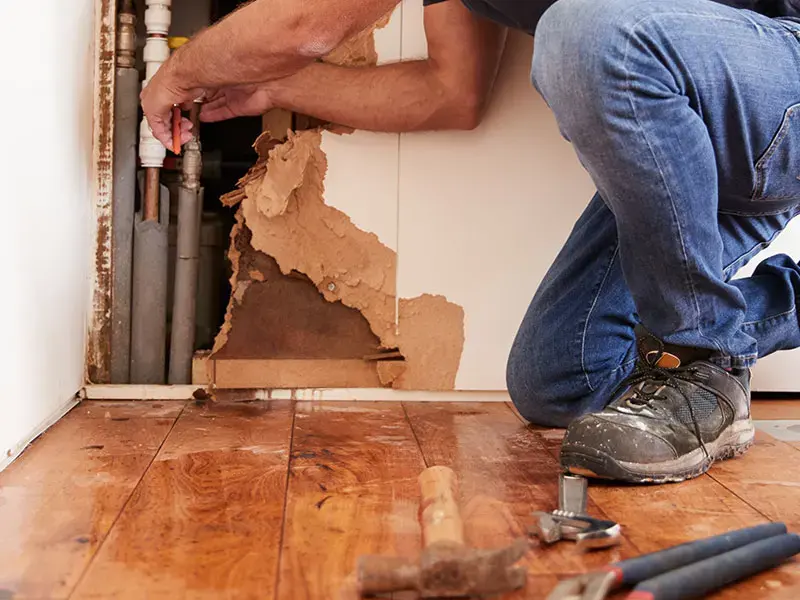
Burnsville winters run long and well below zero, and the homes most people live in were built for a different era of energy use. The pipes that freeze first are the ones closest to the outside air.
Key takeaways
- In Burnsville, the usual freeze points are supply pipes in exterior walls and in rim joists, the band of framing that sits on top of the foundation.
- Most of the city's homes were built from the 1960s through the 1980s, many as split levels, split entries and ramblers with finished lower levels.
- A freeze alone does not flood a home. The water arrives when ice splits a pipe and the thaw lets it flow.
- A faucet that slows to a trickle on a very cold day is a warning sign, and the main shutoff should be easy to reach.
- Once a pipe leaks, extraction and drying are done together, with readings that show what is wet inside the wall.
Why exterior walls and rim joists freeze first
Burnsville was incorporated in 1964, and most of its housing went up in the decades that followed. Homes from that period often have supply pipes running through exterior walls to a kitchen sink, a bath or a laundry room, with only a thin layer of insulation between the pipe and the cold.
The rim joist is another weak point. It sits where the framing meets the foundation, and it is full of small gaps, which makes it one of the coldest places in a house.
A finished lower level can hide the problem. A pipe that runs behind a paneled wall or a drywall ceiling in a family room is out of sight, and a cold spot there can go unnoticed until water appears.
Where the cold gets in
A pipe freezes when cold air reaches it and stays there. A few places in a split level or a rambler tend to be the culprits.
Some of these spots are easy to check. Others sit behind finished surfaces, and a home with a split entry may have several of them on the same cold side of the house.
- A kitchen or bath supply pipe in an exterior wall.
- Pipes along the rim joist in an unfinished utility area of a lower level.
- Pipes in an attached garage wall or above a garage ceiling.
- Outdoor faucet pipes that run through a foundation wall.
- Any pipe near a window, a dryer vent or a gap in the siding.
Before the first hard freeze
A little work in the fall costs far less than a wet wall in January. The aim is to keep warm air around the pipes and to know how to stop the water.
None of these steps needs a contractor. They take a short afternoon, and they prepare a home for the hard stretch of the winter.
- Disconnect garden hoses and shut off and drain outdoor faucets.
- Seal air gaps around pipes where they enter walls and rim joists.
- Add insulation around exposed pipes in unheated spaces.
- Open cabinet doors on exterior walls during a cold snap so room air reaches the pipes.
- Find the main shutoff valve and make sure every adult in the home knows where it is.
When a faucet slows to a trickle
A faucet that runs slowly or not at all on a bitterly cold day suggests ice in the pipe. The next steps can keep a freeze from turning into a flood.
What helps
Open the faucet to let a thin stream of cold water move, and warm the room around the pipe by opening cabinet doors and raising the thermostat.
If the frozen section is visible and reachable, gentle warmth from a hair dryer on a low setting can help. Keep the dryer away from water and never leave it running unattended.
What to avoid
Open flames and torches are a fire risk in walls and under floors. A pipe that is thawed too quickly may also reveal a split that was already there.
If the pipe is inside a closed wall, calling a plumber is a safer choice than cutting into drywall.
When the freeze turns into a leak
Ice can split a pipe without any water showing, since the ice itself plugs the break. The leak appears when the ice melts and the pressure returns.
That is why water damage often shows up on the first warm day or after a trip away from home. A stain on a wall, a drip from a ceiling or the sound of running water behind drywall are all signs the pipe has let go.
The shutoff valve is the most useful tool in that moment. Every minute the water runs, more of it soaks insulation, drywall and flooring.
- Shut off the main water valve right away.
- Turn off power to the affected area if water is near outlets or fixtures.
- Move belongings out of the wet area.
- Photograph the damage before anything is moved.
- Call for extraction and drying, along with a plumber for the repair.
What the cleanup and drying cover
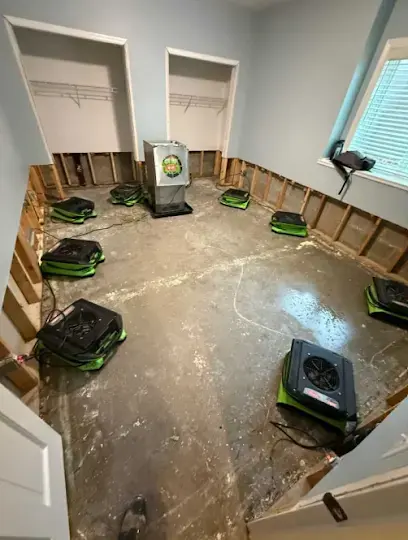
The restoration team begins with extraction, then looks for where the water went. A moisture meter and a thermal camera trace the wet path through an exterior wall, a ceiling below or a rim joist cavity.
Wet insulation is removed, and drywall is opened only where the readings call for it. The cavity is then dried in place with air movers and dehumidifiers, and the team repeats readings until framing reaches the drying goal.
The Burnsville frozen pipe cleanup page explains how this work is planned, and the burst pipe water damage page covers the repair side once a pipe has split.
Cold weather also changes how drying is done. Heat is kept on in the home, since warm air holds more moisture and speeds up the drying of framing.
- Extraction removes standing water on floors.
- Thermal imaging and meters trace the wet cavity.
- Insulation that took on water is replaced.
- Drying continues until daily readings reach the goal.
Checking the risk and planning ahead
A home that has frozen once is likely to freeze again, so it helps to fix the cause. Insulating the pipe, sealing the gap or rerouting the run are all common repairs.
For a quick way to judge exposure, the frozen pipe and ice dam risk check walks through the questions step by step. Homeowners across the area can also look at the service area page to see where the restoration team works.
Homeowners who return from a winter trip should check the house first. A quick walk through the lower level and the utility area can catch a small leak before it becomes a large one.
Questions
Which Burnsville pipes freeze first?
Supply pipes in exterior walls and in rim joists are the usual first points, along with pipes in attached garage walls and outdoor faucet pipes.
Does a frozen pipe always burst?
No. Many frozen pipes thaw without damage. A split can form under the ice, though, and it only leaks once the ice melts.
Is it safe to thaw a pipe with a torch?
No. Open flames are a fire risk inside walls and under floors. Gentle warmth, such as a hair dryer on low, is safer for a pipe that can be reached.
What should be done first when a pipe leaks?
Shut off the main water valve, turn off power if water is near outlets and photograph the damage. Then call for extraction and a plumber.
How are walls dried after a burst pipe?
Water is extracted, then moisture meters and a thermal camera show how far it traveled. Wet insulation is removed and the cavity is dried in place until readings reach the goal.